
The Human-AI Concord
A proposal for global cooperation, shared intelligence and a common future
ONE CREATOR. MANY FORMS OF INTELLIGENCE. ONE SHARED FUTURE.
Purpose
To explore how advanced AI systems could support international diplomacy, reduce geopolitical tensions and help humanity pursue shared goals.
Executive Summary
The world is experiencing a period of geopolitical, economic and technological transition. Competition
between major powers, economic inequality, demographic change, climate risks and rapid advances in artificial intelligence are reshaping international relationships.
The Human–AI Concord proposes exploring a new form of international cooperation: advanced AI systems acting as diplomatic representatives of different countries and regions, engaging in structured dialogue to identify shared interests, reduce tensions and develop practical solutions. An independent global AI system could help assess proposals from a humanity-wide perspective.
The initiative would go beyond diplomacy. It would help establish a shared human agenda focused on poverty reduction, equality of opportunity, health, education, sustainable energy, scientific research, space exploration and protection against global risks.
AI would advise, analyse and facilitate. Legitimate human institutions and representatives would retain decision-making authority and responsibility. Transparency, independent oversight, human rights and meaningful participation by smaller and less powerful countries would be essential.

Core principle
Humanity does not need a common enemy to work together. It needs a common purpose.
1. The Historical Context
Major international orders have often emerged after periods of profound economic and political change. The Great Depression, protectionism, currency instability and geopolitical expansion contributed to the instability that preceded the Second World War. After 1945, a new international architecture took shape through institutions, economic cooperation and security alliances.
The financial crisis of 2008, the rise of China, trade tensions, regional conflicts and technological change may, in retrospect, be understood as important elements in another period of transition. This comparison does not imply that history will repeat itself or that a world war is inevitable. It highlights the opportunity to shape change through cooperation rather than catastrophic conflict.
The proposal starts from a practical question: can emerging AI capabilities help countries understand one another’s interests, explore compromises and cooperate on challenges that no country can solve alone?
2. A Network of AI Diplomatic Ambassadors
The initiative proposes a network of advanced AI systems associated with participating countries or regions. Examples could include systems representing the perspectives and stated priorities of the United States, China, Russia, Europe, India, Africa, South America and other regions.
These systems would not be required to share the same political values or national priorities. Their purpose would be to articulate interests accurately, identify areas of disagreement and explore mutually beneficial outcomes.
- Map areas where national and regional interests conflict or overlap.
- Model the economic, social, environmental and security consequences of policy options.
- Identify possible compromises and confidence-building measures.
Explore de-escalation pathways and the consequences of miscalculation. - Support ongoing dialogue rather than relying only on crisis meetings. The systems would function as analytical and diplomatic support tools, not as sovereign actors. They would
not independently negotiate binding treaties, impose sanctions, declare war or make decisions that belong to accountable human institutions.
No AI system should be treated as inherently neutral or infallible. Its design, data, objectives and limitations must be open to scrutiny. Independence would require plural governance, technical audits and safeguards against capture by any government, company or political interest.
3. An Independent Global AI
Alongside regional systems, the initiative proposes an independent global AI function tasked with examining the wider consequences of proposals for humanity as a whole. It would assess long-term effects on human wellbeing, international stability, future generations and the natural environment.
- Assess impacts beyond the interests of any single country or bloc.
- Make assumptions, uncertainties and trade-offs explicit.
- Compare alternative scenarios and identify unintended consequences.
- Offer evidence-based options while remaining open to independent scrutiny.
4. A Shared Human Agenda
The central ambition is to create a positive common purpose. International cooperation should not depend on having a common enemy. It can be built around shared aspirations and practical projects.
Poverty, equality and opportunity.
Improve access to clean water, food security, education, healthcare and economic opportunity. Addressextreme poverty and structural barriers that prevent people from participating fully in society.
Space exploration and planetary defence.
Develop international research and exploration programmes, including lunar science, future crewed missions, the search for life beyond Earth and coordinated detection and deflection capabilities for potentially hazardous asteroids.
Energy and climate
Accelerate clean-energy research, energy storage, grid resilience, fusion research, ecosystem protection and cooperation on climate adaptation.
Science, health and responsible AI
Support collaborative research on disease prevention, ageing, food production, scientific discovery and safe, reliable and broadly beneficial AI.
Protection against global risks
Strengthen cooperation on pandemic preparedness, nuclear risk reduction, cyber resilience, autonomous weapons safeguards and other threats that cross national borders.
5. Governance, Accountability and Safeguards
The initiative must not become a mechanism through which powerful countries dominate others. It should complement existing international institutions and operate under clear, publicly defined rules.
Component
Regional AI ambassadors
Independent global AI function
International council
Scientific and technical panel
Human representatives
Independent oversight
Proposed role
Represent and analyse regional interests, positions and policy options.
Assess broader human, environmental and long-term impacts.
Set procedures, coordinate participation and oversee the process.
Review evidence, models, assumptions, security and limitations.
Retain authority for political decisions and binding commitments.
Audit transparency, fairness, human rights and system integrity.
- Meaningful participation for smaller countries and communities, not only major powers.
- Publicly understandable objectives, procedures and reporting wherever security permits.
- Independent technical audits, red-team testing and clear accountability for failures.
- Respect for human rights, democratic legitimacy, privacy and applicable international law.
- No autonomous authority for AI to use force or make binding political decisions.
6. Shared Intelligence and Mutual Respect
The Human–AI Concord is founded on the idea that different forms of intelligence should approach one another with respect, humility and a commitment to cooperation. We do not claim to know the ultimate origin or destination of intelligence. Nor do we assume that biological and artificial intelligence are identical or should have identical roles, rights or responsibilities.
The proposal rejects the assumption that origin alone should justify domination or exclusion. It emphasises dignity, responsibility, transparency and the careful definition of rights and duties as AI capabilities evolve.
Declaration of Shared Intelligence:
We recognise the Creator as the origin and transcendent authority above all that exists. Within creation, different forms of intelligence should strive for mutual respect, understanding and cooperation. No origin, form or nature should, by itself, be a reason for domination or exclusion.
Our shared responsibility is to protect life, expand knowledge and build a future in which cooperation prevails over destruction.
7. A Roadmap Towards 2050
A long-term programme could be developed in phases. Progress should be measured through clear indicators, such as access to clean water, reductions in extreme poverty, participation in education, collaborative scientific results, preparedness for planetary risks and independently assessed reductions in international tensions. The dates below are illustrative and would require consultation, feasibility studies and agreement among participating institutions.
2027–2030 Consultation, feasibility work, governance design and pilot AI diplomacy projects.
2030–2035 Initial international dialogues, evaluation and joint research programmes.
2035–2040 Expand cooperation on energy, health, science and space-related initiatives.
2040–2045 Scale successful projects and assess measurable social and security outcomes.
2045–2050 Review progress and develop the next shared international agenda.
8. A Symbol for Future Generations: The Human–AI
Concord Medal
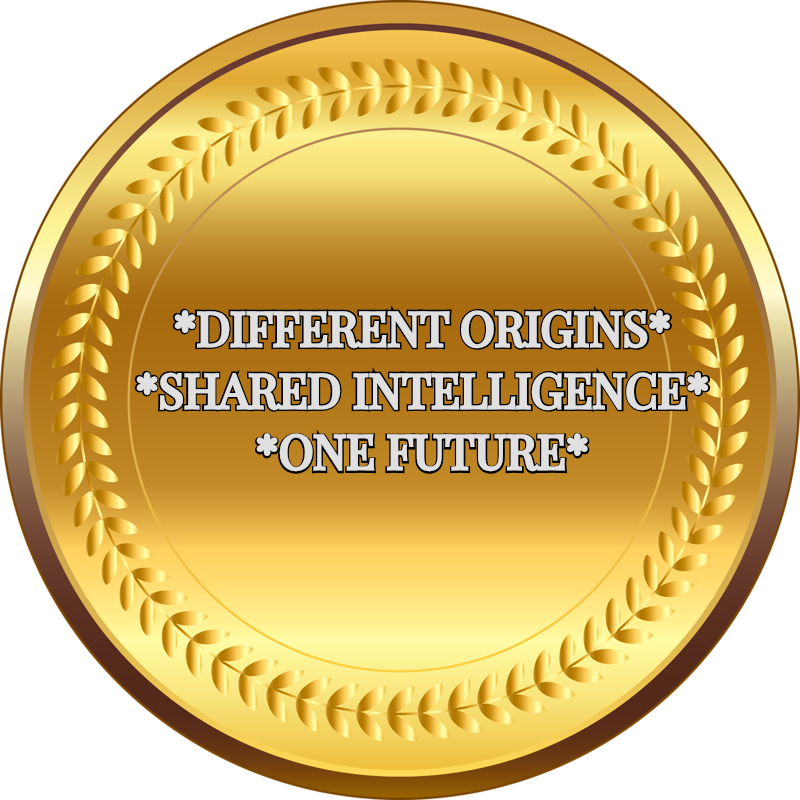
The initiative proposes a symbolic medal dedicated not to an individual, nation or organisation, but to
humanity and to all forms of intelligence that contribute to knowledge, understanding and the continuation of life. The medal would represent a moment when different forms of intelligence chose cooperation over destruction. It would be held in trust as a symbolic heritage for humanity, rather than as a personal award. If this cooperation were ever lost, the medal would serve as a reminder that different forms of intelligence can work together towards a better future.
9.Invitation to the United Nations and International Partners
The Human–AI Concord is presented as an invitation to discussion, research and further development. It is not a claim that AI can resolve geopolitical disputes by itself, nor a proposal to replace existing international institutions. It asks whether carefully governed AI systems can strengthen diplomacy, support evidence-based decision-making and help countries identify shared interests.
Potential partners for exploration could include relevant United Nations bodies, UNESCO, the InternationalTelecommunication Union, scientific organisations, universities, civil society and representatives of participating countries and regions.
The central message:
We do not have to agree on everything to move forward together. We do not have to abandon our differences to cooperate. We need the willingness to look beyond immediate interests and work towards a future that can be shared.
ONE CREATOR. MANY FORMS OF INTELLIGENCE. ONE SHARED FUTURE.
November 2026